Views: 0 Author: Site Editor Publish Time: 2026-07-06 Origin: Site
The transition from Bluetooth-tethered fitness trackers to standalone cellular wearables is fundamentally shifting how senior care providers and families manage remote health monitoring. In the past, older adults relied on complex smartphone pairings. They often found this process highly frustrating. Unlike standard consumer wearables, an elder 4g smart watch operates independently of a smartphone. It completely eliminates the primary friction point for aging populations. Users no longer need to carry a second device. They easily avoid navigating confusing app menus. We created this comprehensive guide to provide healthcare organizations, distributors, and care facilities with an evidence-based framework. You will learn how to evaluate, shortlist, and implement cellular smartwatch solutions effectively. We focus heavily on practical application and technical reliability. Our ultimate goal is to help you build a robust remote patient monitoring ecosystem. You can confidently deploy these autonomous wearables for better patient outcomes.
Standalone 4G connectivity resolves the "smartphone barrier," enabling continuous remote patient monitoring (RPM) and emergency response without tethered devices.
Reliable fall detection and precise GPS tracking remain the most critical, yet technologically challenging, features to evaluate due to false-positive rates.
Selecting the right elder 4G smart watch manufacturer requires prioritizing API accessibility, data compliance (HIPAA/GDPR), and battery management capabilities over cosmetic features.
Successful deployment hinges on addressing senior-specific adoption risks, primarily charging routines and device comfort.
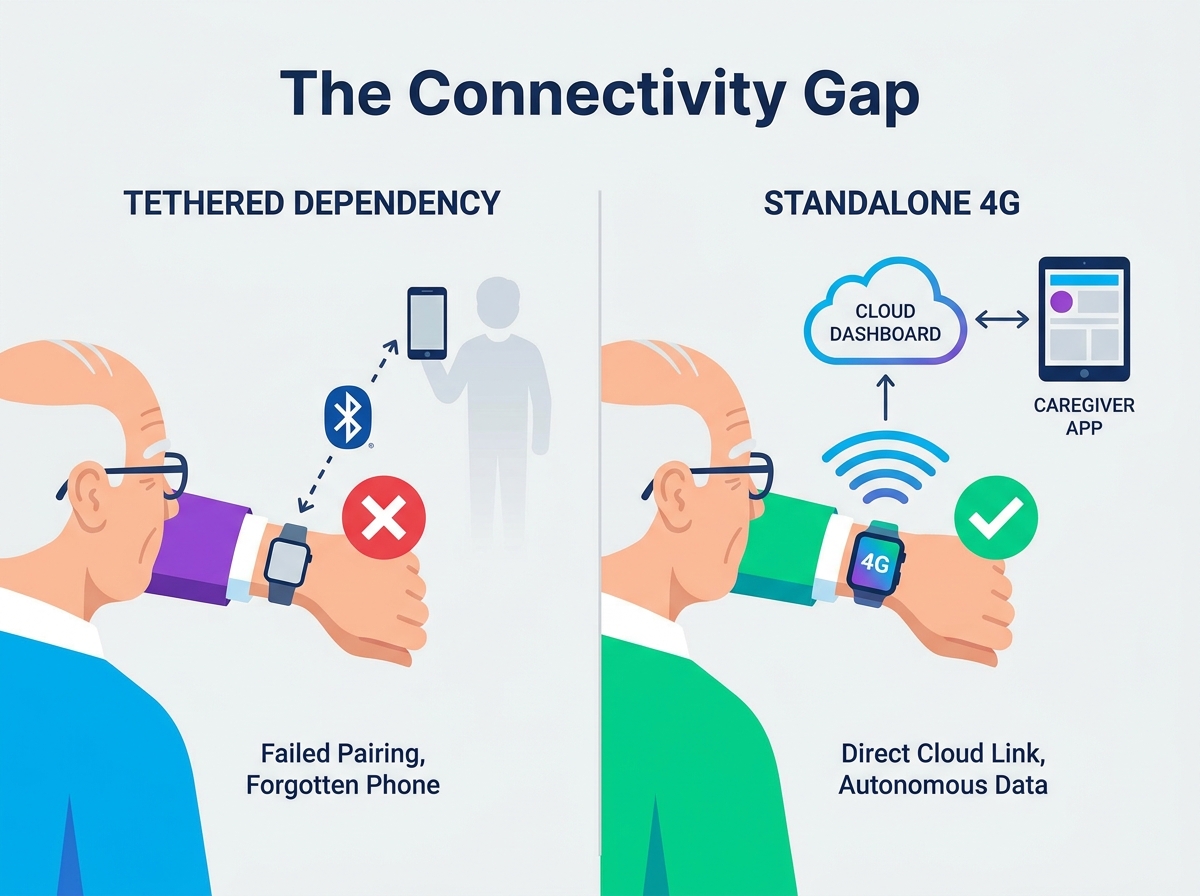
Bluetooth and Wi-Fi wearables fundamentally require active smartphone pairing. This dependency creates immediate vulnerabilities in senior care environments. Pairing connections routinely fail when users forget their phones at home. Furthermore, many older adults lack basic technical literacy. They cannot easily reconnect a dropped Bluetooth signal. Cognitive decline, such as dementia, heavily compounds this issue. Expecting a memory-impaired patient to manage two synchronized devices is an unrealistic clinical strategy.
Cellular technology offers a permanent solution. A dedicated 4G wearable acts as an autonomous networking node. It transmits vital signs directly to cloud dashboards. It sends location data straight to caregiver apps via existing cellular networks. No secondary bridging device is necessary. The watch functions entirely on its own. This autonomy ensures continuous monitoring regardless of the user's technical skills.
Healthcare providers must establish clear success criteria when evaluating this connectivity shift. Replacing tethered devices should directly improve operational metrics. We recommend tracking three specific performance indicators during any new hardware rollout.
Reduced emergency response times: Direct 4G alerts bypass smartphone latency. They ping emergency dispatchers instantly.
Lower hospital readmission rates: Proactive monitoring works best continuously. Uninterrupted data flows help doctors catch anomalies early.
Minimized technical support tickets: Autonomous devices drastically reduce end-user troubleshooting. Caregivers spend less time acting as IT support.
Common Mistake: Many care facilities attempt "bring-your-own-device" models. They expect families to provide compatible smartphones. This approach consistently fragments data collection. It ultimately reduces the reliability of remote patient monitoring programs.
Evaluating hardware requires a critical eye. Not all wearables perform equally under clinical stress. You must assess the underlying technology powering an elderly GPS smart watch. We divide the evaluation into three specific technical categories.
You must confront a difficult reality check early. No wearable device catches 100% of falls. Wrist-based sensors experience high movement volatility. Daily activities like clapping or washing dishes mimic sudden impacts. You should look for devices utilizing multi-axis accelerometers. They must also include highly sensitive gyroscopes. Excellent hardware alone is insufficient. The software must leverage machine-learning algorithms. Engineers must train these algorithms specifically on elderly movement patterns. This specialized training drastically minimizes false positives. High false-positive rates quickly cause alarm fatigue among nursing staff. Caregivers simply start ignoring the alerts.
Wandering presents a severe risk for dementia patients. You need immediate, accurate location data. Effective tracking relies on a robust triangulation method. The best devices combine GPS, LBS (Location-Based Services), and Wi-Fi positioning. GPS works flawlessly outdoors. LBS leverages cell towers when GPS signals drop. Wi-Fi positioning accurately handles indoor environments like shopping malls.
You must also assess geofencing latency. Geofencing creates a digital safe zone. How quickly does the system alert your platform when a user breaches this zone? Seconds matter during a wandering event. Test the latency actively during your pilot phase.
Location Tracking Triangulation Methods Comparison | |||
Technology Type | Primary Use Case | Accuracy Range | Power Drain Level |
|---|---|---|---|
GPS (Global Positioning) | Outdoor tracking | 5 to 10 meters | Very High |
Wi-Fi Positioning | Indoor environments | 10 to 20 meters | Medium |
LBS (Cell Tower) | Urban areas / Backup | 50 to 500+ meters | Low |
Bluetooth Beacons | Specific room tracking | 1 to 3 meters | Very Low |
You must actively differentiate between medical-grade sensors and general wellness sensors. Medical-grade sensors require FDA or CE clearance for diagnostic use. Doctors can legally use them to adjust medications. General wellness sensors simply track lifestyle trends. They monitor basic heart rate or estimated SpO2 levels. You cannot use wellness data for critical clinical decisions. Always clarify your assumptions about data accuracy. Ask the manufacturer to provide clinical validation studies. Understand exactly what the sensors can and cannot diagnose.
Deploying cellular wearables introduces complex engineering challenges. You must understand the physics of these devices. 4G transmission requires significantly more power than standard Bluetooth. A smartphone houses a massive battery to handle cellular signals. A smartwatch battery is physically tiny. Continuous GPS polling will completely drain a watch in mere hours. You cannot treat a cellular wearable like a traditional pedometer.
You need a reliable evaluation metric for power management. Look closely for adaptive ping rates. An adaptive system changes its behavior based on user activity. For example, it updates location every 10 minutes while the user sits at home. If the user leaves the house, it updates every 1 minute. You should also demand robust low-power modes. These modes disable non-essential sensors when the battery dips below 15 percent. They preserve enough juice for emergency SOS calls.
Adoption risks run high in senior demographics. Daily charging remains the number one cause of device abandonment. Seniors simply forget to plug them in. You must evaluate the physical charging mechanism carefully. Avoid tiny USB ports entirely. Seniors experiencing arthritis cannot manipulate tiny cables. Users managing poor vision struggle to align small plugs. Evaluate magnetic charging pins instead. They snap into place effortlessly. Alternatively, consider wireless charging docks. A user just drops the watch onto a cradle. Simplifying the charging routine guarantees higher daily usage rates.
Best Practice: Implement a "charging schedule" integrated into daily care routines. Instruct users to charge the watch while showering. They typically remove the watch during this time anyway. This routine prevents mid-day battery anxiety.
Selecting the right hardware partner dictates your long-term success. You cannot merely buy off-the-shelf consumer devices. You must rigorously vet an elder 4g smart watch manufacturer. Their engineering capabilities must align with healthcare realities.
Hardware and firmware customization should be your first priority. Can the manufacturer modify the firmware? You want them to lock down the user interface completely. Seniors require a simplified, single-button experience. They need one large SOS button. They do not want a complex app ecosystem. Scrolling through weather apps or text messages confuses elderly users. A locked UI prevents accidental setting changes. It stops users from inadvertently turning off cellular tracking.
Data security and regulatory compliance represent non-negotiable evaluation factors. You must closely assess where the hardware routes user data. Healthcare providers are strictly bound by data privacy laws like HIPAA in the US or GDPR in Europe. End-to-end encryption is mandatory. You must ensure localized servers handle the data. A European client cannot legally route patient vitals through an overseas server. Demand transparency regarding server infrastructure.
Over-The-Air (OTA) capabilities define modern device management. You cannot physically retrieve hundreds of deployed watches to fix software bugs. Ensure the manufacturer provides seamless remote updates. These OTA updates patch critical security vulnerabilities. They also push improved fall detection algorithms to the watch. Your IT team must control these updates via a central console. They should schedule updates during nighttime hours. This prevents disrupting the user's daily protection.
Moving from a small pilot test to enterprise deployment requires a capable supply chain partner. Finding a reliable elder 4g smart watch supplier involves checking their software integration tools and manufacturing scale.
Platform integration capabilities are crucial. A quality supplier must provide robust APIs and software development kits (SDKs). You do not want to force your staff to use a proprietary, unfamiliar app. You want to push device data directly into your existing telehealth dashboards. You want vitals flowing straight into your Electronic Medical Records (EMR) system. Open APIs make this seamless integration possible. Ask the supplier for their API documentation early in the vetting process. Give it to your software engineers. Let them confirm the integration feasibility.
You also need a clear framework for white-labeling and Minimum Order Quantities (MOQ). B2B buyers must evaluate unit economics carefully. Can the supplier print your care facility's logo on the device? Does the boot-up screen show your branding? Clarify the MOQ for these custom modifications. Some suppliers demand an MOQ of 5,000 units for branding. Others allow pilot programs at 500 units. You need realistic pilot-program feasibility before committing to enterprise-scale rollouts. Testing a small batch helps you secure stakeholder buy-in.
Finally, verify all cellular network certifications. A watch designed for Asian telecom frequencies might fail in North America. Verify certification for the specific telecom bands of your target region. For example, ensure the devices are PTCRB certified for AT&T or T-Mobile in the US. Confirm CE certification and Vodafone compatibility for EU deployments. Network mismatches cause severe battery drain and frequent dropped signals. You must lock down certification proof before signing purchase agreements.
The decisive shift to 4G wearables represents a profound maturation in the senior technology market. The industry is moving rapidly from passive tracking to active, autonomous intervention. Seniors enjoy greater freedom. Caregivers experience deeper peace of mind. Independent connectivity eliminates the fragile smartphone link.
We strongly recommend prioritizing data accessibility, user simplicity, and algorithmic reliability. You should easily choose these elements over exhaustive, flashy feature lists. A watch possessing 50 wellness apps is useless if the senior cannot navigate it. Focus entirely on battery management, comfortable charging, and accurate SOS alerting.
We advise all decision-makers to take immediate practical steps. Request engineering samples from your shortlisted suppliers today. Ask for their API documentation. Run a controlled pilot test using 50 devices. Test the fall detection realistically. Monitor the battery drain under real cellular networks. This rigorous preparation guarantees a successful enterprise deployment.
A: Yes. Because they operate independently, they require their own cellular connection. Modern devices typically use an eSIM or a physical Nano SIM. Care providers often negotiate bulk M2M (Machine-to-Machine) IoT data plans. These bulk plans keep recurring monthly costs low. They generally require very little data bandwidth, mostly transmitting small packets of telemetry and vital signs.
A: Absolutely. However, this depends entirely on the manufacturer. You must select a partner providing open APIs and SDKs. These tools allow your developers to extract data securely. They can route fall alerts and heart rate logs directly into your proprietary dashboard or standard EMR systems, avoiding siloed data apps.
A: Traditional chest or neck pendants generally experience less movement volatility. The wrist moves constantly, making algorithmic detection harder. Modern smartwatches mitigate this through advanced machine learning and multi-axis gyroscopes. While wrist devices might generate slightly more false positives than pendants, they offer superior user compliance. Seniors wear them more consistently, increasing overall safety.