Views: 0 Author: Site Editor Publish Time: 2026-07-09 Origin: Site
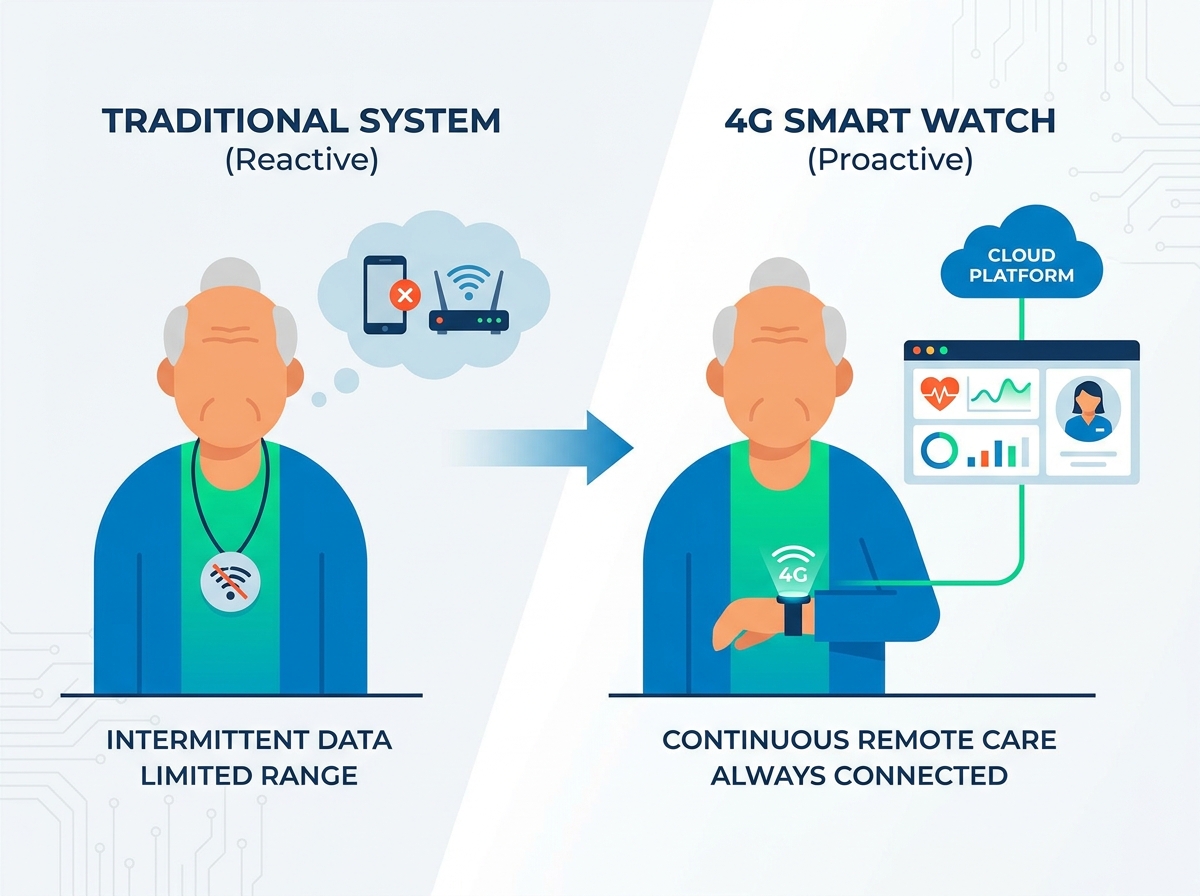
The transition from basic medical alert pendants to comprehensive, wrist-worn wearables has shifted elder care from reactive emergency response to proactive health management. Traditional solutions often tethered users to a base station in their living room. This severely limited their daily independence. While Bluetooth and Wi-Fi-dependent devices fail abruptly when seniors leave the house, standalone cellular connectivity bridges the gap entirely. It offers uninterrupted data transmission for high-risk demographics, regardless of their location. This connectivity is vital for immediate crisis intervention and family peace of mind. This guide provides a detailed technical and operational framework for evaluating an elder 4g smart watch. We will cut through common marketing claims to focus squarely on clinical reliability, deployment realities, and vendor selection criteria. You will learn exactly how to assess hardware, understand AI limitations, and secure reliable enterprise partners.
Standalone 4G connectivity is non-negotiable for continuous remote care, eliminating reliance on paired smartphones or home Wi-Fi networks.
Effective AI health monitoring requires evaluating hardware sensor accuracy (ECG, PPG) against acceptable clinical deviations and false-positive rates.
Battery life and charging mechanisms are the primary adoption bottlenecks in elder care technology; realistic expectations and magnetic charging solutions are critical.
Selecting a reputable elder 4g smart watch manufacturer requires vetting their data privacy compliance (GDPR/HIPAA), API integration capabilities, and post-sale technical support.
Traditional wearables often rely on tethered connections. They require a paired smartphone or a stable home network to function. This creates a significant connectivity gap. When older adults walk to the grocery store or visit a local park, Bluetooth devices lose their connection entirely. Home network outages also render Wi-Fi-dependent pendants useless during power failures. You cannot rely on these fragmented systems for life-saving alerts. Standalone cellular technology eliminates this exact vulnerability.
A dedicated SIM card embedded in the wearable ensures continuous data transmission. It allows the device to communicate directly with cellular towers. Real-time syncing happens automatically. Vital signs, sudden fall detection alerts, and precise geolocation data stream continuously. Care facility dashboards receive these updates without delay. Family members can view real-time status through secure mobile apps. You gain a constant line of sight into the wearer’s well-being, independent of their technical literacy.
However, continuous cellular connectivity introduces a clear battery trade-off. We must transparently address battery physics. Pushing data across cellular bands drains small lithium-ion batteries much faster than standard Bluetooth protocols. Leading hardware designs mitigate this drain through intelligent engineering. They utilize dynamic ping rates. The wearable might update location every hour during normal activity. If the user triggers an SOS, the ping rate accelerates to every thirty seconds. Low-power sleep modes also conserve energy when internal accelerometers detect no physical movement.
Single-source tracking fails frequently in real-world scenarios. Pure satellite tracking struggles indoors or among tall urban buildings. To ensure reliable tracking, modern wearables must utilize a multi-tiered positioning system. We evaluate devices based on their hybrid tracking architecture.
Global Positioning System (GPS): Provides high accuracy outdoors under clear skies.
Location-Based Services (LBS): Triangulates position using nearby cellular towers when satellite signals fail.
Wi-Fi Positioning: Scans surrounding router MAC addresses to pinpoint indoor locations accurately.
Assisted GPS (AGPS): Uses cellular data to download satellite almanac information, drastically reducing the time required to lock onto a location.
Geofencing represents another crucial tracking capability. Families and care providers draw virtual boundaries around homes or neighborhoods. When the user crosses this boundary, the system generates an alert. You must understand geofencing latency realities. The alert generation depends entirely on the device's ping frequency. A ten-minute interval means a wandering senior could travel a significant distance before the system notifies you. Adjusting these intervals balances safety against battery preservation.
Artificial intelligence drives modern fall detection. We must deconstruct the underlying algorithms. Basic devices only use accelerometers to measure sudden impacts. Advanced wearables combine gyroscopes and accelerometers. AI pattern recognition analyzes the entire sequence of movement. It looks for a sudden downward acceleration followed by an extended period of complete stillness.
This multi-sensor approach addresses the pervasive false positive problem. Care providers ignore devices generating constant false alarms. High-quality algorithms distinguish between a senior suffering a hard fall and someone simply dropping the watch onto a bedside table. When a genuine event occurs, two-way Voice over LTE (VoLTE) calling becomes critical. The wearable acts as a speakerphone on the wrist. Clear audio quality ensures emergency dispatchers can assess the situation even if the wearer cannot move their arm.
Wearable health monitoring bridges the gap between clinical visits and daily life. You must differentiate between consumer-grade estimates and clinical diagnostics. Modern wearables track heart rate, blood pressure, and blood oxygen saturation (SpO2). They use Photoplethysmography (PPG) sensors. These sensors shine green light into the skin to measure blood volume changes.
These optical sensors provide valuable trending data. They do not replace traditional medical cuffs. We use smartwatches to track baseline deviations over time. You should view these devices as early-warning systems rather than definitive diagnostic instruments.
Health Metric | Smartwatch Role (Trend Tracking) | Clinical Tool Role (Diagnostic) |
|---|---|---|
Blood Pressure | Identifies daily fluctuations and abnormal spikes using optical PPG sensors. Requires regular calibration. | Provides precise systolic/diastolic measurements using physical pneumatic cuffs. |
Heart Rate | Monitors resting heart rate and flags sudden tachycardia during rest periods. | Offers detailed 12-lead ECG mapping to diagnose specific arrhythmias. |
Blood Oxygen (SpO2) | Highlights overnight drops in oxygenation which may indicate sleep apnea. | Uses medical-grade pulse oximeters to dictate immediate respiratory interventions. |
Artificial intelligence also excels at analyzing sleep and daily activity algorithms. The software establishes a unique behavioral baseline for each user. It monitors daily step counts, sleep duration, and general mobility. AI algorithms flag sudden decreases in activity levels. A sudden drop in daily movement often precedes major health events. Catching these early behavioral changes allows care teams to intervene before a minor issue requires hospital admission.
We must apply a skeptic's lens to all health features. Emphasize their limitations clearly to patients and families. No consumer or enterprise smart watch serves as a certified diagnostic tool. They exist solely to prompt professional medical evaluation. Setting accurate expectations prevents users from ignoring severe symptoms simply because their watch shows normal readings.
Deploying technology to older adults involves significant user adoption hurdles. Physical design necessities dictate a successful deployment. Many seniors suffer from arthritis, reduced tactile sensitivity, or poor vision. Engineers must accommodate these physical realities. A successful interface requires large UI icons and high-contrast screens. Physical SOS buttons remain mandatory. Touchscreens fail during high-stress emergencies or when fingers are wet.
Charging mechanisms often represent the single biggest adoption bottleneck. Traditional micro-USB cables frustrate users with poor dexterity. We recommend simplified magnetic charging cables. The pogo-pin connectors snap into place effortlessly. This small hardware choice drastically improves daily compliance. If they cannot charge it easily, they will not wear it.
Data security and privacy demand rigorous scrutiny. You are transmitting highly sensitive personal health information over cellular networks. Examine the underlying cloud infrastructure carefully. Where does the server route the health data? Regional data protection laws govern this transmission. You must ensure the chosen solution complies with the Health Insurance Portability and Accountability Act (HIPAA) in the US. European deployments require strict adherence to the General Data Protection Regulation (GDPR). Data must remain encrypted both in transit and at rest.
The platform ecosystem dictates operational scalability. Assess the software providing the backend oversight. Families often use a simple companion app for peer-to-peer monitoring. Nursing homes and enterprise care agencies need a different architecture. They require an enterprise dashboard. This centralized portal must allow staff to monitor fifty or more devices simultaneously. It should offer hierarchical access controls, automated reporting, and fleet management capabilities.
Enterprise buyers must thoroughly evaluate their hardware partners. When engaging an elder 4g smart watch supplier, hardware customization capabilities determine your market success. You must decide between Original Equipment Manufacturer (OEM) and Original Design Manufacturer (ODM) models. Standard white-label devices offer faster deployment. Custom ODM projects allow for specific modifications.
Casing Modifications: Evaluate waterproofing standards. Devices must achieve IP67 or IP68 ratings to survive showers and baths, where many falls occur.
Sensor Upgrades: Assess their ability to integrate advanced medical-grade sensors or larger battery capacities based on your specific demographic needs.
Band Materials: Ensure the availability of hypoallergenic silicone or breathable nylon straps to prevent skin irritation on fragile tissue.
Software and API flexibility represent a critical evaluation point for healthcare providers. Isolated data silos render wearables useless for large organizations. The supplier must provide open RESTful APIs. These programming interfaces allow you to pull raw device data. You can then integrate this payload directly into existing hospital or care-agency Electronic Health Record (EHR) systems. Without robust API support, staff waste time manually transcribing data.
Navigating B2B purchasing requires strict attention to Quality Control and Minimum Order Quantities (MOQs). Understand the supplier's production capacity. MOQs usually begin around 500 to 1,000 units for customized branding. Negotiate clear warranty terms covering battery degradation and screen failures. Investigate the manufacturer's historical defect rate. High-quality production lines maintain defect rates below two percent. Request exhaustive pilot testing before committing to large volume purchases.
The right wearable device successfully balances robust cellular connectivity with a senior-centric physical design.
Hardware accuracy matters, but identifying behavioral trends through AI offers the most actionable medical insights.
Enterprise deployment relies heavily on selecting vendors offering open APIs, strict privacy compliance, and scalable fleet management dashboards.
Magnetic charging solutions and physical SOS buttons drastically increase daily wearer compliance.
Encourage your procurement team to prioritize reliable hybrid positioning over long lists of superficial marketing features. Mitigating false positives saves care staff countless hours. You should immediately request a live software demo from your shortlisted vendors. Review their technical specification sheets carefully. Contact a vetted supplier today to initiate a limited pilot program within your care facility.
A: Yes. Standalone cellular watches require an active SIM card and a dedicated data plan. Enterprise deployments typically use specialized IoT data plans. These plans prioritize small, frequent data packets. Average monthly data consumption ranges between 30MB and 100MB, keeping operational costs low compared to standard smartphone plans.
A: Smartwatches use optical PPG sensors to estimate blood volume changes. They cannot match the clinical accuracy of a traditional pneumatic cuff. Users must calibrate the watch regularly using a standard cuff. The device excels at identifying abnormal daily trends rather than providing certified diagnostic measurements.
A: Realistic battery life typically spans 24 to 48 hours. Continuous 4G transmission and satellite tracking drain batteries quickly. Battery longevity depends entirely on the location update frequency. Setting shorter ping intervals drains power faster. Caregivers must establish a daily charging routine for the wearer.
A: Yes, integration is entirely possible. Top-tier manufacturers provide open APIs and webhooks. These tools allow nursing homes to route real-time location and health data directly into their existing Electronic Health Record (EHR) systems. Many suppliers also offer white-label enterprise dashboards for immediate deployment.