
Views: 0 Author: Site Editor Publish Time: 2026-06-02 Origin: Site
Parents face a difficult decision when choosing a child’s first phone. They want their child to stay reachable when walking home, attending activities or spending time with relatives. At the same time, many are concerned about introducing social media, short-form videos, mobile games and unrestricted internet access too early.
The concern is understandable. The 2025 Common Sense Census reports that children aged eight and under still spend about 2.5 hours per day using screen media, while gaming time has increased substantially since 2020. Screen use is not automatically harmful—content, context and family routines all matter—but these trends help explain why more families are looking for simpler communication tools. (Common Sense Media)
For some children, the most appropriate first phone — or first communication device — may therefore be a screen-free communication device rather than a conventional smartphone.
Modern smartphones are designed to do much more than make calls. They provide access to app stores, games, social networks, video platforms, web browsers and continuous notifications.
These functions can be useful for adults, but they may also make it harder for younger children to develop consistent digital boundaries. A child may receive a smartphone primarily for safety, yet quickly begin using it as an entertainment device.
Common concerns include:
Distraction during homework and family activities
Exposure to inappropriate online content
Social media pressure
Late-night device use
In-app purchases and mobile gaming
Difficulty separating communication from entertainment
The World Health Organization recommends that children and adolescents aged 5–17 average at least 60 minutes of moderate-to-vigorous physical activity per day while limiting sedentary time. A simpler communication device cannot create healthy habits on its own, but it can reduce access to some of the digital features that compete with offline activities. (World Health Organization)
A screen-free phone is a simplified device designed primarily for communication and safety. Depending on the model, it may support voice calling, approved contacts, emergency SOS functions or location services without providing an open app ecosystem.
Typical features include:
Voice communication
Parent- or administrator-approved contacts
Simple physical controls
No social media or entertainment applications
No unrestricted web browsing
Optional SOS and location functions
“Screen-free" does not necessarily mean that the device has no network connection. For example, a Wi-Fi SIP phone still requires an IP network to make calls. The important distinction is that the child does not receive open access to browsers, app stores and entertainment platforms.
These devices are intended to create a more controlled communication environment—not to replace parental supervision or guarantee complete safety. For families that mainly need calling rather than apps and entertainment, a screen-free phone can be a simpler alternative to a smartphone.
Different families and deployment projects require different types of devices.
| Category | Home Wi-Fi Communication Device | Portable 4G Communication Device |
Primary use | Communication at home or school | Communication while travelling |
Connectivity | Wi-Fi and SIP | 4G cellular network |
Mobility | Used in a fixed location | Portable or wearable |
Location tracking | Usually not required | GPS, Wi-Fi or LBS positioning |
Emergency function | Depends on configuration | Usually includes an SOS button |
Best suited for | Homes, classrooms and supervised spaces | School commutes and outdoor activities |
A Wi-Fi device may be suitable for a younger child who needs to call parents from home but does not need a mobile phone. A portable 4G device is more appropriate when parents need communication and location support outside the home.
The KAER KS21 is a screen-free Wi-Fi SIP phone designed for simple voice communication in fixed environments such as homes, schools and supervised activity spaces.
Instead of requiring children to navigate apps or menus, the KS21 uses straightforward physical controls. It connects through 2.4 GHz or 5 GHz Wi-Fi and supports SIP-based voice calling without requiring a SIM card.
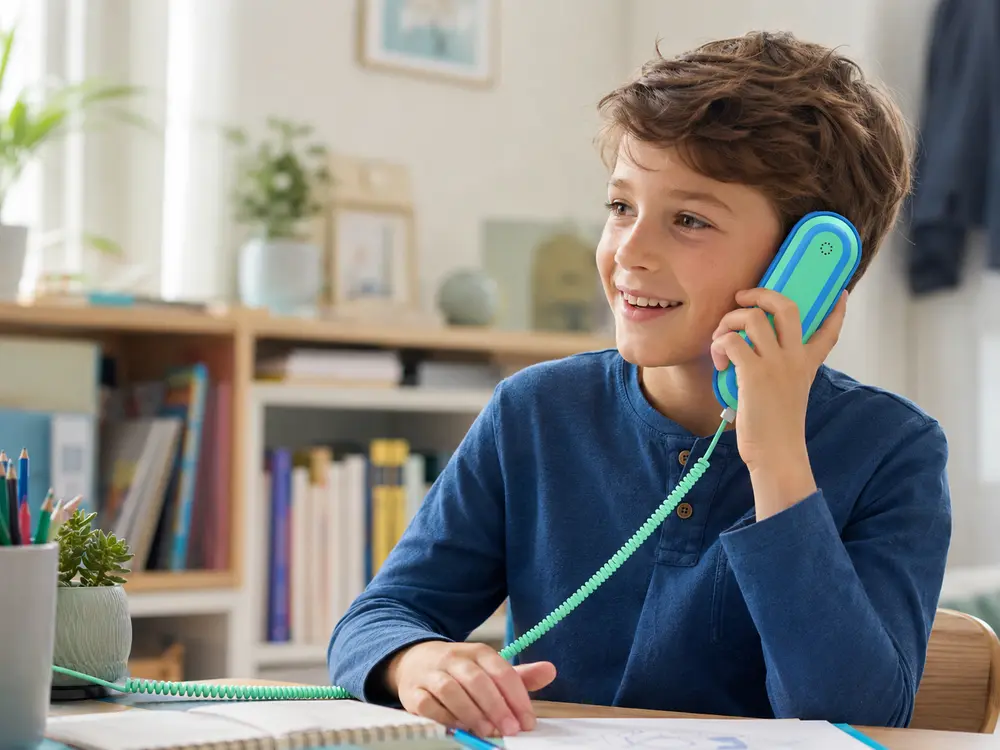
Key capabilities include:
Screen-free design
Wi-Fi and SIP calling
Simple physical operation
No open browser or app store
Web-based device management
OTA firmware updates
Desktop-style placement
The KS21 is particularly relevant for families that want children to contact approved family members from home without giving them a conventional smartphone. It can also support schools, education providers and telecom operators developing controlled communication services.
Because the KS21 depends on Wi-Fi and SIP infrastructure, buyers should confirm network configuration, SIP platform compatibility and contact-management requirements before deployment.
Children who walk to school, attend extracurricular activities or travel independently may need a portable solution. The KAER HC02 is designed for mobile communication and everyday safety scenarios.

Depending on the final project configuration, its core capabilities can include:
4G LTE communication
Two-way voice calling
GPS, Wi-Fi and LBS positioning
One-touch SOS communication
Simplified child-friendly operation
Remote device management
The HC02 allows children to stay connected without carrying an unrestricted smartphone. It may also help parents or care teams check a child’s approximate location when necessary.
Location performance depends on satellite visibility, nearby Wi-Fi information, cellular coverage and platform configuration. Before launching the device in a specific country, buyers should also confirm local LTE frequency bands, SIM requirements and applicable privacy regulations.
Screen-free communication products are increasingly relevant to telecom operators, distributors, schools, education groups and private-label consumer electronics brands. However, product selection should be based on the deployment scenario rather than a single feature list.
Buyers should evaluate:
Determine whether the product will be used at home, at school, during a commute or for outdoor activities. A stationary Wi-Fi phone and a portable 4G device solve different problems.
For Wi-Fi SIP devices, confirm compatibility with the intended SIP platform and network environment. For 4G products, verify operator coverage, SIM specifications and LTE bands in every target market.
Clarify how contacts are added, approved and updated. Schools and large service providers may require centralized administration rather than individual device setup.
Children's communication and location data require careful handling. Buyers should assess data storage, access permissions, platform security and local privacy requirements before deployment.
Commercial projects may operate for several years. Firmware maintenance, component availability, technical support and replacement-device planning are therefore as important as the initial hardware price.
A small pilot deployment is recommended before a larger rollout.
Founded in 1996, KAER develops communication hardware for international markets. The company supports OEM and ODM projects for brands, operators, distributors and solution providers.
Available project services may include:
Product branding and packaging
Firmware and button-function customization
SIP or platform integration
Language and regional configuration
4G frequency-band adaptation
Device management integration
Sample testing and volume production
Customization availability depends on technical feasibility, certification requirements and order volume.
A child’s first communication device does not necessarily need social media, games, video platforms or unrestricted internet access.
For children who mainly need to call family members from home, a Wi-Fi SIP device such as the KAER KS21 offers a simpler option. For children who need communication and location support while travelling, a portable 4G device such as the HC02 may be more suitable.
The objective is not to eliminate technology. It is to introduce technology gradually, based on the child's age, daily routine and actual communication needs.
Looking for a screen-free communication device for your market? Contact KAER with your target country, network requirements, deployment scenario and estimated volume to discuss samples, technical specifications and OEM/ODM options.
It can provide a more controlled environment by removing open browsing, social media and entertainment apps. However, no device can guarantee a child’s safety, and parental guidance remains essential.
It depends on the product. A Wi-Fi SIP phone requires network access for calling but does not need to provide open internet browsing. A 4G device uses a cellular connection and SIM card.
The KS21 is primarily intended for fixed locations with configured Wi-Fi and SIP service. For mobile use, a portable 4G device is usually more appropriate.
No. Location tracking is generally more relevant to portable 4G products. Stationary home communication devices may not require GPS.
KAER supports OEM and ODM development, including branding, firmware, regional network configuration and platform integration, subject to project evaluation.


